Liverpool Air Quality Research Centre

University-grade air quality intelligence for industry.

LARC is a state-of-the-art University of Liverpool laboratory delivering commercial air quality evidence. We combine high-performance sensing, SEM-EDX, biological sampling, field deployment and environmental data analysis so clients can measure, prove, defend and improve decisions.

High-performance sensors · SEM-EDX · Biological sampling · Freeport skills · NHS, ports, airport, council and international deployments
University of Liverpool logo
NHS logo
Liverpool John Lennon Airport logo
Peel Ports or Port of Liverpool logo
Liverpool City Council logo
KEMRI logo
University laboratory capability, commercially deliveredField monitoring, sampling, analysis and reporting under one LARC-led offer.
From field deployment to board-level evidenceAir quality intelligence that clients can act on.

A university laboratory with commercial delivery built in.

LARC gives industry access to university-grade facilities, specialist scientific staff and deployable monitoring capability without needing to build an in-house air quality team. LARC leads the science, sampling strategy, field deployment, laboratory analysis, QA/QC and interpretation. Liverpool Sensors provides the enabling sensor and data platform, including the client login route for live dashboards, maps and downloads.

Freeport skills and regional growth

Built from Liverpool City Region Freeport Skills investment.

LARC’s dedicated air quality assessment and mitigation capability is linked directly to the Liverpool City Region Freeport agenda: cleaner port operations, digital logistics, maritime decarbonisation, green skills and practical environmental monitoring around communities close to major freight and port activity.

The Freeport Skills investment enabled new university facilities, calibration capability and regional monitoring infrastructure. LARC converts that infrastructure into training, commercial service delivery and a skills pipeline for the city region.

Training and upskilling we can provide: practical sensor deployment, air quality fieldwork, calibration and QA/QC, SEM-EDX sample interpretation, environmental data analytics, dashboard use, digital twin concepts, port emissions evidence, and CPD-style short courses for local authorities, port operators, consultants, employers and students.

Commercial value: organisations can use LARC to train staff, validate interventions, evidence clean operations, support planning or ESG requirements, and develop new services around air quality, maritime decarbonisation and environmental intelligence.


01

Skills pipeline

Hands-on training in sensor engineering, deployment, calibration, data analytics and environmental evidence.

02

Port evidence

Monitoring and interpretation for Freeport activity, freight corridors, shoreside power and cleaner port operations.

03

Digital tools

Dashboards, live data, mapping, downloads and digital twin-style modelling for targeted interventions.

04

Industry training

CPD, consultancy, demonstration projects and bespoke upskilling for councils, ports, employers and firms.

What LARC does

We turn environmental risk into evidence clients can use.

LARC supports organisations that need credible information about air pollution, dust, biological material, exposure, emissions or site impacts. We are not just selling sensors. We sell confidence: a properly designed measurement campaign, robust data handling, laboratory analysis where required, and a report that can stand up in front of clients, regulators, boards, planning teams and communities.

That means we can help a council understand neighbourhood air quality, a developer manage dust risk, a port evaluate emissions, an airport evidence local impacts, a hospital investigate exposure pathways, or a technology company validate a new sensing product in real-world conditions.

01

Deploy

High-density outdoor, indoor and wearable monitoring using robust field-ready sensing systems.

02

Sample

Particles, dust, biological material and site-specific environmental samples collected with purpose.

03

Characterise

SEM imaging and EDX elemental analysis to understand what material is present, not just how much.

04

Commercialise

Dashboards, reports, evidence packs, product trials and partnership models that generate value.

Sensing and deployment

High-performance sensing packages, built for real-world decisions.

Our sensing offer is designed for clients who need more than a cheap monitor and a spreadsheet. We provide carefully selected sensors, calibration-aware deployment, live data infrastructure, maintenance, QA/QC and interpretation. This can be delivered as a one-off campaign, a retained monitoring service or a long-term managed network.

Outdoor sensing

Air quality monitoring across streets, sites and communities.

Outdoor monitoring for councils, ports, airports, construction sites, schools, commercial estates and research programmes. Our systems are built for dense spatial coverage, rapid installation, live telemetry and defensible QA/QC.

  • PM₂.₅, PM₁₀, NO₂, CO₂ and supporting meteorology
  • Calibrated, bias-corrected and quality-flagged datasets
  • Solar, mains, battery and hybrid deployment options
  • Perimeter, receptor, hotspot and neighbourhood monitoring
  • Live dashboards, alerts, APIs and data downloads
  • Field maintenance, calibration checks and reporting

Indoor sensing

Evidence on ventilation, comfort, exposure and building performance.

Indoor sensing for homes, schools, workplaces, hospitals, care settings and public buildings. We help clients identify poor ventilation, overheating, indoor particulate sources and building-level exposure risks.

  • CO₂, PM, temperature, humidity and occupancy-linked interpretation
  • Indoor/outdoor sensor pairs
  • Ventilation, overheating and building performance studies
  • Managed monitoring for estates, housing, schools and healthcare
  • Before-and-after evaluation of interventions
  • Clear reports for leadership teams

Wearable sensing

Personal exposure monitoring for studies and targeted campaigns.

Wearable and portable sensing to understand what people are actually exposed to as they move through homes, streets, workplaces and transport environments.

  • Personal exposure studies for workers, patients, pupils and volunteers
  • Route, commute, occupational and microenvironment monitoring
  • Integration with location, activity, diary and survey data
  • Exposure profiles for trials and interventions
  • Ethics-aware workflows for research and health partnerships
  • Commercial packages for employers and estates teams
Outdoor sensor deployment
Dashboards and live data
Port and logistics monitoring

Why our sensors sell

Low-cost sensing, treated like serious instrumentation.

Lots of organisations can buy a sensor. Far fewer can make the data credible. LARC combines field-ready sensor platforms with university-led calibration, co-location, bias correction, environmental QA/QC and expert interpretation.

  • Designed for deployment, not demonstration

    Built around real sites: weather exposure, power constraints, connectivity, access, maintenance and long-term data continuity.

  • Calibration-aware from the start

    We can co-locate, correct, validate and quality-flag data so clients understand uncertainty.

  • Dense networks at commercially realistic cost

    Spatial coverage that would be difficult or impossible using reference instruments alone.

  • Live intelligence, not static monitoring

    Dashboards, APIs, alerts, data downloads and reporting pipelines turn measurements into a service.

New analytical capability for air quality evidenceSEM imaging, EDX elemental analysis and sample-led investigation.

Laboratory analysis

State-of-the-art university analysis for commercial environmental questions.

LARC’s SEM and EDX capability allows clients to go beyond concentration numbers and ask what particles are, what they may be made from, and whether site activity, local sources or environmental conditions may be contributing.

Scanning Electron Microscopy

High-resolution particle imaging to examine morphology, surface features and sample characteristics.

EDX elemental analysis

Elemental characterisation to support source investigation, dust analysis, site comparison and product assessment.

Commercial evidence packs

Sampling plans, contextual metadata, QA/QC, imagery, elemental results and interpretation packaged for clients.

Sample-led environmental investigationDust, particles, filters, bioaerosol sampling and source-led campaigns.
Analytical depth for commercial decisionsSEM-EDX and biological sampling add detail that sensors alone cannot provide.

Sampling services

Biological sampling, bacteria investigation and building site evidence.

For some questions, a sensor alone is not enough. LARC can design sampling campaigns that bring together air quality monitoring, environmental sampling and lab analysis.

  • Biological and bioaerosol sampling

    Sampling strategies for airborne biological material, including bacteria and microbial signals in indoor or outdoor environments.

  • Building site and construction dust sampling

    Perimeter monitoring, particulate sampling, event investigation, SEM-EDX analysis and reporting.

  • Indoor environmental sampling

    Support for homes, workplaces, schools, healthcare settings and public buildings.

  • Source-led sampling campaigns

    Integrated measurement and laboratory analysis for ports, roads, airports, industrial sites and hotspots.

Commercial routes

Ways industry can work with LARC.

LARC is built to generate value for external partners while bringing commercial income into the university. We can deliver direct services, retained monitoring, specialist analysis, product validation, collaborative R&D and strategic partnerships.

Managed monitoring

Air quality as a service.

Recurring revenue through managed indoor, outdoor or wearable monitoring packages.

  • Monthly or annual monitoring contracts
  • Construction site and perimeter monitoring retainers
  • Estate-wide indoor air quality monitoring
  • Port, airport and logistics corridor networks

Laboratory services

SEM-EDX and sample characterisation.

Chargeable laboratory analysis for dust, particles, filters, deposition samples and suspected source material.

  • SEM imaging packages
  • EDX elemental analysis packages
  • Dust and particle source investigation
  • Commercial evidence reports

Product validation

Independent testing for environmental technology companies.

Companies developing sensors, filters, ventilation systems or environmental products need credible third-party evaluation.

  • Sensor performance trials
  • Co-location and calibration studies
  • Before-and-after intervention testing
  • Independent evaluation reports

Strategic partnerships

University R&D without building your own lab.

LARC can work with industry through consultancy, contract research, Innovate UK projects, KTPs, PhD sponsorship, testbed access and co-developed services.

  • Contract research and consultancy
  • Grant-funded industry collaborations
  • Sponsored PhDs and student projects
  • Technology pilots and demonstration sites

Proven delivery

Real projects, real partners, real-world air quality decisions.

LARC is built from active work with public sector, health, airport, city-region and international partners.

NHS and clinical exposure partnerships

LARC works with health-facing partners to connect air quality measurement with exposure, vulnerable populations and practical public health questions.

For NHS-linked work, LARC can provide sensing packages, indoor assessment, wearable exposure monitoring, interpretation and evidence packs.

Public healthIndoor/outdoor exposureWearablesClinical partnerships

Liverpool John Lennon Airport

LARC has delivered airport-facing air quality monitoring and evidence generation for Liverpool John Lennon Airport.

This demonstrates support for airports and transport operators with monitoring design, deployment, QA/QC, interpretation and reporting.

Airport monitoringTransport emissionsStakeholder evidenceCommercial reporting

Liverpool Freeport, ports and maritime evidence

LARC’s Freeport-linked capability is designed for portside air quality, freight corridors, maritime emissions and communities living close to logistics activity.

This creates a commercial route for port operators, logistics firms, local authorities and technology companies needing defensible monitoring and upskilling.

Freeport skillsPortsMaritime emissionsTraining

Liverpool City Council and city-region evidence

LARC has supported local authority air quality activity through city-focused monitoring, interpretation and evidence generation.

For councils and public bodies, LARC can deliver dense monitoring, dashboards, policy-ready reporting, public engagement and intervention evaluation.

Local authorityNeighbourhood networksDashboardsPolicy evidence

KEMRI, Clean Air Africa and international sensor networks

LARC’s work extends beyond Liverpool through Clean Air Africa and partnerships including KEMRI, supporting large-scale sensing activity in Kenya.

This strengthens LARC’s commercial offer: practical deployment in challenging environments, scalable networks, partner training and data infrastructure.

Clean Air AfricaKEMRI80+ monitors in KenyaInternational deployment

Use cases

Where we can make clients money, save money or reduce risk.

LARC supports compliance, planning, reputation, product development, occupational health, estate management and investment decisions.

Construction and demolition

Dust, PM, boundary monitoring, complaints investigation, particle composition analysis and evidence packs.

Local authorities

Neighbourhood networks, schools, traffic interventions, hotspot mapping and public-facing evidence.

Ports and maritime sites

Portside monitoring, freight corridors, shipping-related emissions, Freeport evidence and community exposure.

Healthcare and public health

Indoor/outdoor exposure, vulnerable settings, clinical research partnerships and health-linked monitoring.

Housing and buildings

Ventilation, overheating, CO₂, damp-linked concerns and indoor particulate exposure.

Sensor and product validation

Independent trials, co-location, calibration, performance summaries and field-testing of new technologies.

How projects work

From site question to clear recommendation.

1. Scope the question. We identify the site, pollutants, samples, receptors, likely sources, timeline and decision.

2. Design the plan. We choose the right mix of sensors, wearables, sampling methods and laboratory analysis.

3. Deploy and collect evidence. We install equipment, collect samples, manage field notes and maintain QA/QC.

4. Analyse and interpret. We combine sensor data, SEM-EDX, biological sampling, weather and site context.

5. Report what matters. We deliver reports, dashboards, data files, figures, recommendations and stakeholder summaries.

Team

Science, delivery and technical capability in one place.

Replace the placeholder images with real photography when ready.

Jonny Higham placeholder

Jonny Higham

Director

Air quality monitoring, sensing networks, environmental data science and commercial translation.

Michal Motylinski placeholder

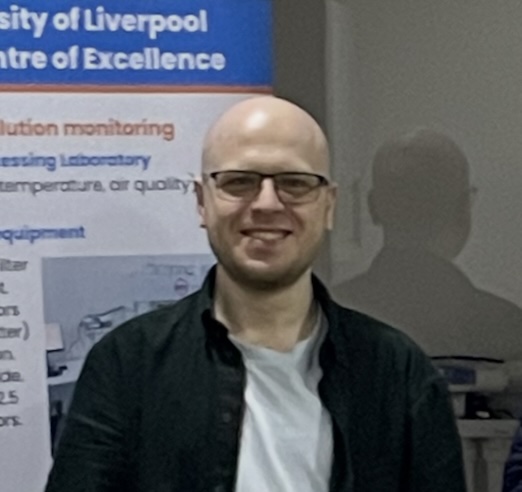
Michal Motylinski

Technical Lead

Field systems, deployment support, hardware integration and operational delivery.

Andy Plater placeholder

Andy Plater

Director of Ports and Environment

Ports, coastal systems, maritime environments and place-based environmental research.

Dan Pope placeholder

Dan Pope

Director of Global Partnerships

Public health, international collaboration and exposure-focused environmental research.

Rachel Simpson placeholder

Rachel Simpson

PhD Researcher

Air quality campaigns, sampling, monitoring and environmental analysis.

George Overton placeholder

George Overton

PhD Researcher

Field monitoring, research support, data analysis and deployment activity.

Contact

Bring us the site. We will build the evidence package.

Use this page for commercial sensing jobs, retained monitoring contracts, biological sampling, SEM-EDX analysis, indoor studies, construction monitoring, product validation, consultancy or R&D.

Project enquiry

This enquiry form sends directly to the LARC team through the site mailer.

Useful details to include

  • Site and setting Address, site type, access constraints, power availability and whether the work is indoor, outdoor or wearable.
  • Question What are you trying to prove, understand, monitor or rule out?
  • Commercial need Compliance, planning, product validation, occupational health, stakeholder assurance, estate management or R&D.
  • Sampling need Sensors, biological sampling, dust sampling, SEM-EDX, or a combined package.
  • Timeline and outputs Quote, report, dashboard, data export, figures, evidence pack or stakeholder summary.
  • Response route Include the best contact person, timeline and any reporting deadline.